-
Partager cette page
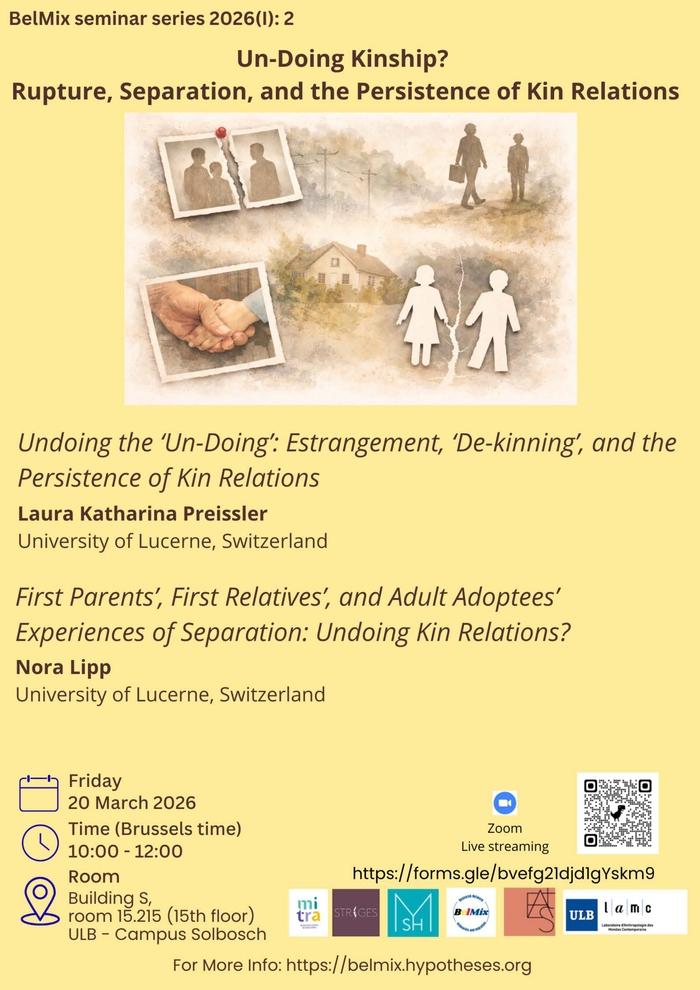
BelMix Seminar Series : "Undoing the ‘Un-Doing’: " by Laura Katharina Preissler and “First Parents’ Nora Lipp
We are pleased to invite you to our upcoming BelMix seminar, scheduled for 20 March.
This will be a dual-presentation session featuring Laura Katharina Preissler, who will give a talk entitled “Undoing the ‘Un-Doing’: Estrangement, ‘De-kinning’, and the Persistence of Kin Relations”, and Nora Lipp, who will present their research entitled “First Parents’, First Relatives’, and Adult Adoptees’ Experiences of Separation: Undoing Kin Relations?”
This session will exceptionally take place from 10:00 AM to 12:00 PM in Room S.15.215 (Building S, 15th floor). You may also join us online via Zoom; please see below for further information.
We look forward to welcoming many of you to this event.
Best regards,
The BelMix Seminar organizing committee
********
When: Friday 20 March 2026, 10 AM to 12 PM (Brussels Time)
Where: Room S.15.215 (Building S, 15th floor), Campus Solbosch, Université libre de Bruxelles (ULB), Avenue Jeanne 44, Bruxelles 1050.
And live-streamed online via Zoom. Register here to receive the link:
https://forms.gle/bvefg21djd1gYskm9
First presentation: “Undoing the ‘Un-Doing’: Estrangement, ‘De-kinning’, and the Persistence of Kin Relations” by Laura Katharina Preissler (University of Lucerne, Switzerland)
Abstract:
Both the New Kinship Studies and the emerging scholarship on family estrangement explore rifts and separations between close kin. In anthropology, the term ‘de-kinning’ emerged in transnational adoption studies and has since been applied more broadly to describe the alleged ending of kin relations. More recently, anthropologists have also described estrangement itself as a form of ‘de-kinning’.
In fields such as communication studies or sociology, conflicts and the termination of contact between kin are subsumed under the term familial estrangement, framed in concepts such as ‘relationship dissolution’ or ‘not doing family’. While anthropological discourse in this context has been more explicit in asking what constitutes kin relations, estrangement research has focused on lived experiences and the consequences of severed ties, sometimes also questioning the ‘involuntariness’ of parent-child bonds. Although these literatures rarely cross-reference one another, they converge on the assumption that kin relations can, in some sense, be ‘undone’.
In this talk, I do three things: first, I examine how analytically useful the concept of ‘de-kinning’ really is for thinking about the supposed ‘undoing’ of filial relations. Second, I review how estrangement has been conceptualised beyond ‘de-kinning’ in anthropology and related disciplines and put these approaches into dialogue with each other. Finally, I return to my critique of interactional frameworks of kinship in the context of estrangement and propose an alternative perspective.
While estrangement is socially consequential and transforms how kin relations are lived, it does not erase kin relations as such. Social relationships may be suspended, yet the facts of birth and of having been raised by someone, as well as a shared past and shared relatives, remain – often as a haunting presence that continues to shape lives long after contact has ceased.
Biography:
Laura Preissler completed her bachelor’s degree in Cultural Studies with a focus on Social Anthropology at the University of Lucerne. After earning her master’s degree at Maastricht University, she worked for five years as a research assistant at the University of Lucerne within the research focus Family Change in the Context of Migration and Globalisation. In this context, she conducted her doctoral project on parenting in Switzerland. Laura Preissler is currently a postdoctoral researcher in the SNSF-funded project De-Kinning and Re-Kinning? Estrangement, Divorce, Adoption and the Transformation of Kin Networks. Her research explores processes of estrangement between parents and their adult children in Switzerland, examining how kin networks are transformed through tension, conflict, and the cessation of contact.
Second presentation: “First Parents’, First Relatives’, and Adult Adoptees’ Experiences of Separation: Undoing Kin Relations?” by Nora Lipps (University of Lucerne, Switzerland)
Abstract:
Drawing on ethnographic research with first parents, first relatives, and adult adoptees in Russia, this paper examines how people live through and make sense of separation in the context of adoption and fostering. Building on the anthropology of child circulation and engaging with Signe Howell’s concept of 'de-kinning', I question whether kin relations can be severed. While Howell describes 'de-kinning' as producing a 'socially naked' child, I ask whether the embodied experience of bearing and giving birth to a child – or the biographically fixed fact of being born to someone – can ever be erased.
Adoption and fostering, as state-managed practices of reassigning children to new families, seek to transform or erase prior relations through legal means. Yet the experiences and narratives of first parents, first relatives, and adult adoptees show that kin relations persist and remain relevant – emotionally, morally, and imaginatively – beyond institutional frameworks. The ongoing relevance of these relations challenges the idea that kin relations can be administratively terminated.
By bringing into view those whose experiences are often kept “out of sight” in public and in anthropological discourse, this paper traces how first parents, first relatives, and adult adoptees continue to navigate kin relations despite the rupture at the interactional level. In doing so, I argue that, rather than a clean-cut 'de-kinning', separation produces complex and often ambivalent effects, such as guilt, regret, longing, and secrecy. This argument complicates binary notions of kinship and its dissolution.
Biography:
Nora Lipp holds a master’s degree in Cultural Studies from the University of Lucerne. She is currently part of the SNSF-funded project De-Kinning and Re-Kinning? Estrangement, Divorce, Adoption and the Transformation of Kin Networks, within which she is conducting her doctoral research on how separation in the context of adoption in Russia affects kin ties, focusing on the experiences of first parents and their wider kin networks.
10h à 12h
ULB - Campus Solbosch
Bâtiment S - 15ième étage
S.15.215
44 avenue Jeanne - 1050 Bruxelles
And live-streamed online via Zoom. Register here to receive the link: HERE